
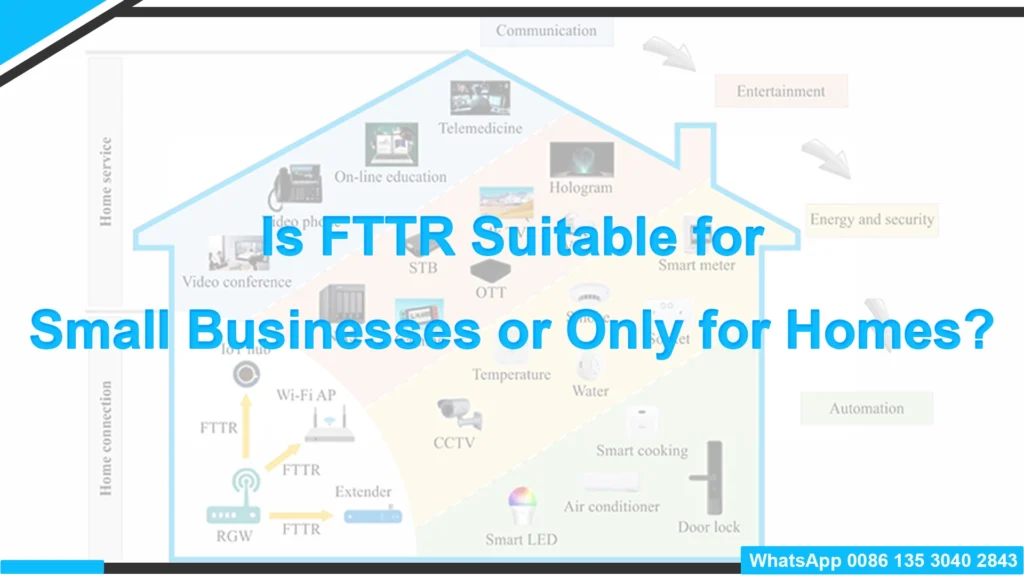
A Practical Guide to Fixing Wi‑Fi Dead Zones in Offices, Shops, and Hotels
If you run a small business, you know the specific panic of the “buffering” icon appearing right in the middle of a client video call or a payment transaction. For years, the solution to weak Wi-Fi was simple: buy a range extender or a consumer-grade mesh system.
But recently, a new acronym has entered the networking conversation: FTTR (Fiber to the Room).
Initially marketed heavily toward high-end smart homes, many business owners are asking: Is this just a luxury gadget for gamers, or is it the infrastructure upgrade my business actually needs?
This guide breaks down what FTTR is, how it differs from the fiber you already have, and why it might be the secret weapon for small businesses struggling with connectivity.
1. What Is FTTR Really Solving for You?
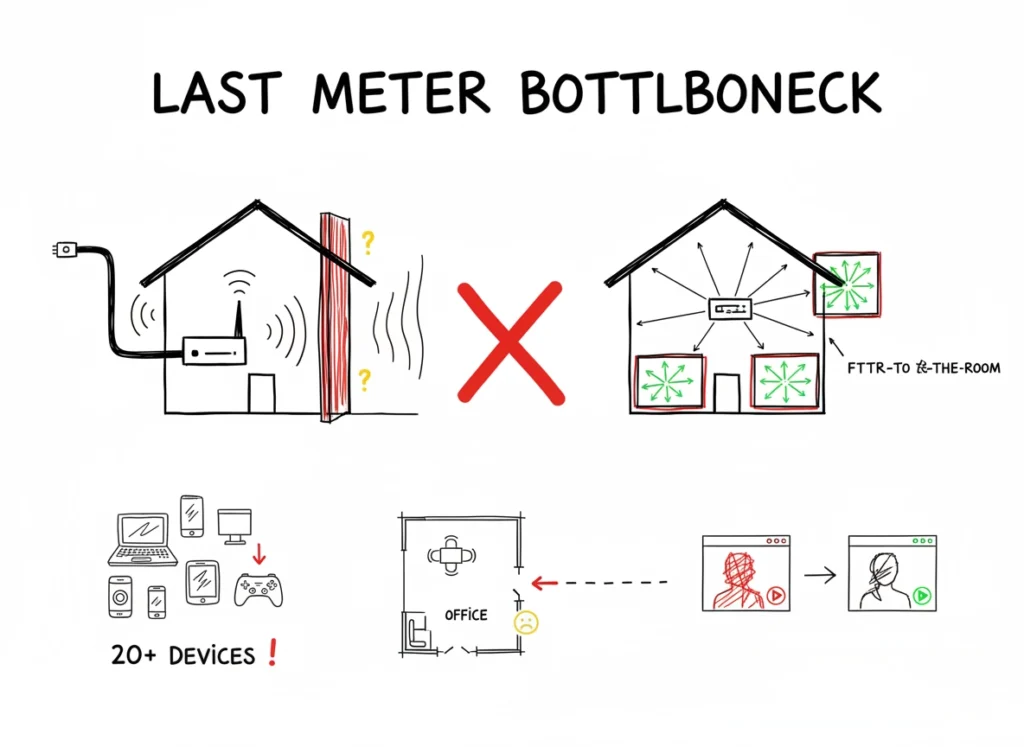
To understand FTTR, you have to understand the “Last Meter Bottleneck.”
Most businesses already have a fast internet connection coming to the building. But once that speed hits your main router, it hits a wall—literally. Wi-Fi signals degrade rapidly as they pass through concrete, metal studs, and glass partitions.
Fiber to the Room (FTTR) is not just a fancy router upgrade. It is an architectural shift. Instead of relying on radio waves (Wi-Fi) to push data through walls, FTTR extends the actual optical fiber cables into each key room or area.
It solves specific, real-world pain points:
Multi-device Concurrency: When 20 staff members and 15 smart cameras are online simultaneously.
The “Corner Office” Problem: Fixing dead zones in rooms furthest from the reception desk.
Latency Spikes: Eliminating the lag that causes video meetings to freeze and VoIP calls to sound robotic.
2. FTTH vs. FTTR: Why Your Current Fiber Is Not Enough
You might be thinking, “I already pay for Fiber internet. Why do I need this?”
There is a critical difference between the fiber you have now and FTTR.
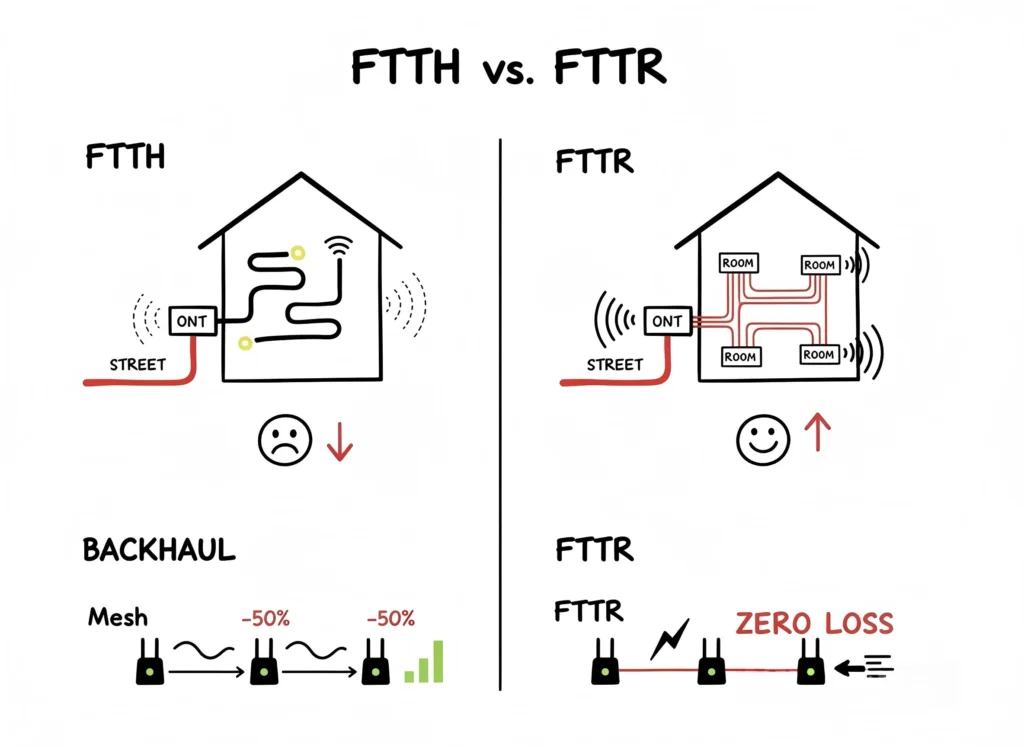
FTTH (Fiber to the Home/Business): The ISP runs a fiber cable from the street to a single box (ONT) inside your front door or server closet. From that point on, your internet travels over old-fashioned copper ethernet cables or, worse, purely over the air via Wi-Fi.
FTTR (Fiber to the Room): This takes the fiber connection from that main box and continues it deep into every room.
The “Backhaul” Advantage
The connection between your satellite Wi-Fi units and the main router is called the “backhaul.”
Mesh Systems: Use wireless backhaul. They use radio waves to talk to each other. If the signal is blocked by a wall, the speed drops by 50% or more with every “hop.”
FTTR: Uses optical fiber backhaul. The data travels at the speed of light through glass cables to the access point in the room. There is zero signal loss, regardless of distance or walls.
| Feature | FTTR (Fiber to the Room) | Standard Mesh Wi-Fi | FTTH + Extender |
|---|---|---|---|
| Backhaul Technology | Optical Fiber (Glass) | Radio Waves (Wireless) | Copper / Ethernet |
| Speed Loss per Room | 0% Loss | 15-50% Loss per hop | High Loss (Distance dependent) |
| Max Potential Speed | Up to 10 Gbps | 1-2 Gbps (Real world) | < 1 Gbps |
| Latency (Ping) | < 10ms (Stable) | Variable (Jitter prone) | High |
| Best For | Business / Large Homes | Small Apts / Open plans | Single Room |
3. Is FTTR Overkill for a Normal Home or Small Business?
Honesty is key here: Not everyone needs FTTR.
When you DON’T need it:
If you operate a small studio apartment, a pop-up kiosk, or a one-room shop (under 60sqm) where the router is visible to everyone, FTTR is unnecessary. A high-quality Wi-Fi 6 router will cover you perfectly.
When you DO need it:
If your space has complex layouts, multiple floors, or thick structural walls, standard Wi-Fi struggles. The “sweet spot” for FTTR includes:
3+ Bedroom Homes: Where gaming happens in one room and 4K streaming in another.
Duplex Offices: Where the router is downstairs but the meeting room is upstairs.
High-Density Environments: Small spaces with a massive number of devices (e.g., a smart office with automated lights, blinds, and sensors).
4. Is FTTR Only for Homes? Where It Fits Small Businesses
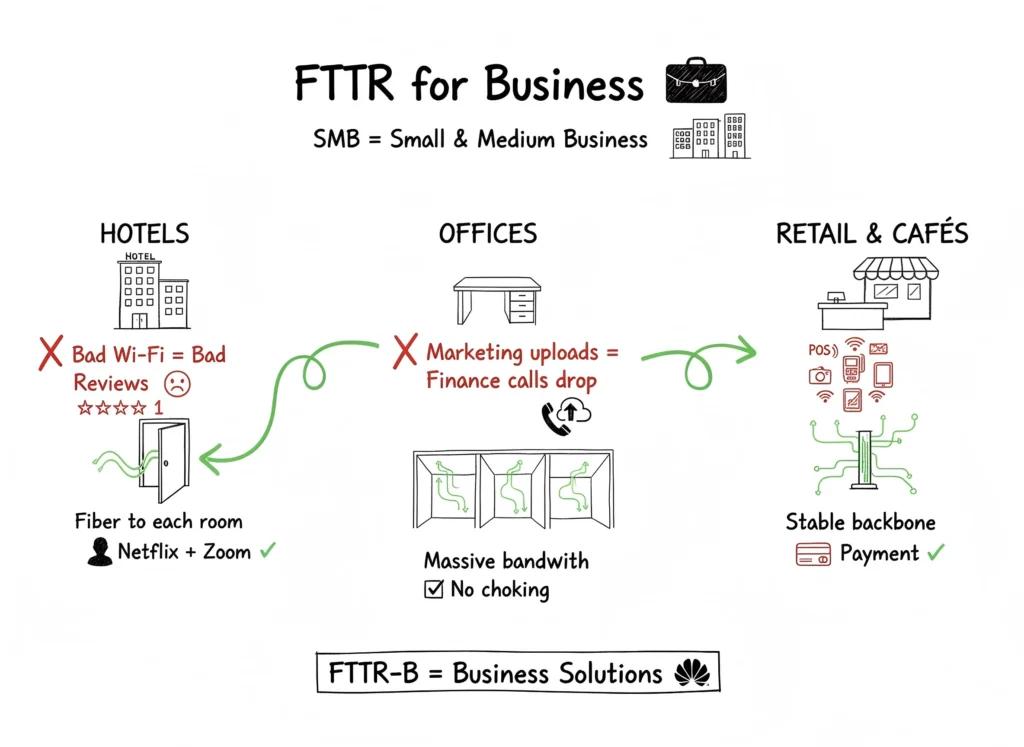
While marketing often features families on iPads, the technology is explicitly positioned for the SMB (Small and Medium Business) sector. In fact, industry giants like Huawei have launched specific FTTR-B (Business) solutions tailored for commercial needs.
Here is where it fits best:
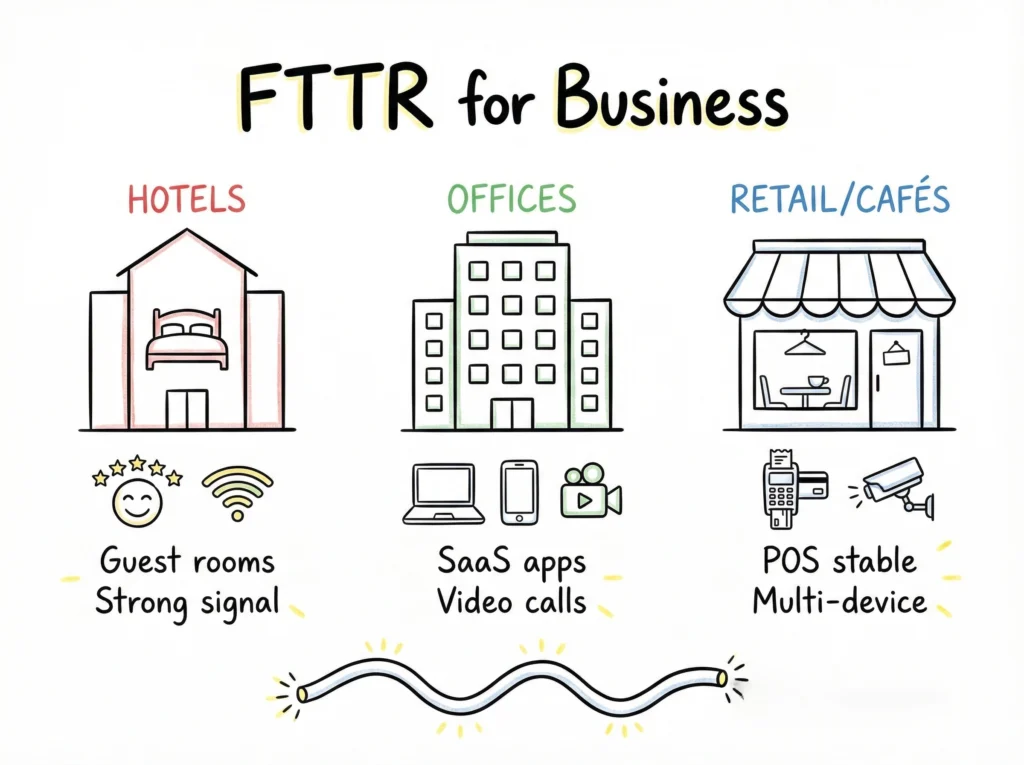
4.1 Hotels, Guesthouses, and Homestays
In the hospitality industry, “Bad Wi-Fi” is the number one killer of online reviews—worse than a bad breakfast.
The Problem: Traditional hotel Wi-Fi relies on hallway access points that struggle to penetrate heavy fire doors into guest rooms.
The FTTR Fix: Fiber runs directly into the guest room. Every guest gets their own “private” high-speed connection for streaming Netflix or taking Zoom calls, resulting in higher guest satisfaction scores.
4.2 Small and Medium Offices
Modern offices rely on SaaS (Software as a Service). If the internet jitters, productivity stops.
The Problem: In a shared office, if the marketing team starts uploading 4K video files, the finance team’s VoIP phones stop working.
The FTTR Fix: The massive bandwidth capacity of fiber means heavy traffic in one room doesn’t choke the speed in the next room.
4.3 Retail Stores, Cafés, and Restaurants
The Problem: Your POS system, security cameras, UberEats tablet, and guest Wi-Fi are all fighting for the same bandwidth.
The FTTR Fix: FTTR provides a stable backbone. It ensures that a customer streaming YouTube in the corner doesn’t prevent your credit card machine from processing a payment.
5. Key Benefits That Matter to Small Business Owners
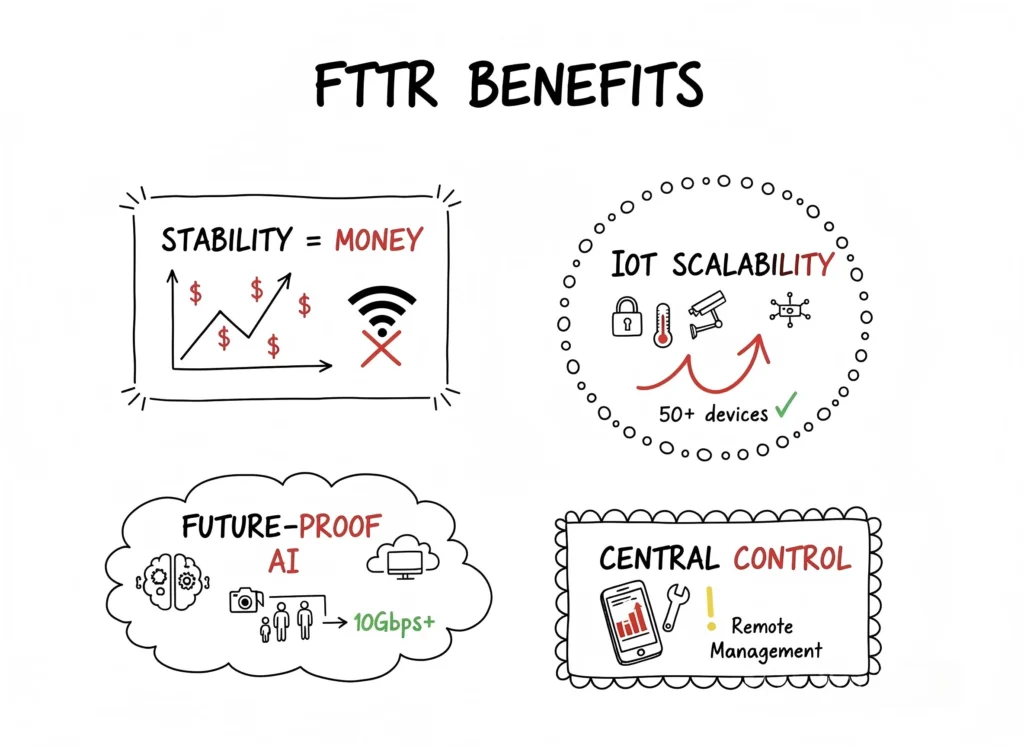
Beyond just “speed,” FTTR offers operational benefits:
Stability is Money: It reduces random disconnections. In a business, downtime isn’t just annoying; it costs revenue.
IoT Scalability: As you add smart locks, connected thermostats, and IP security cameras, your network gets crowded. Fiber handles high device counts (concurrency) much better than copper or wireless mesh.
Future-Proofing for AI: As businesses move toward AI video analytics (e.g., counting foot traffic in stores) and cloud desktops, the demand for bandwidth will triple. Fiber installed today will handle the speeds of tomorrow (10Gbps and beyond).
Centralized Management: Most FTTR business packages come with an app that allows you (or your IT provider) to see exactly which device is hogging bandwidth and fix issues remotely.
6. Will FTTR Destroy My Renovation? Installation and Aesthetics
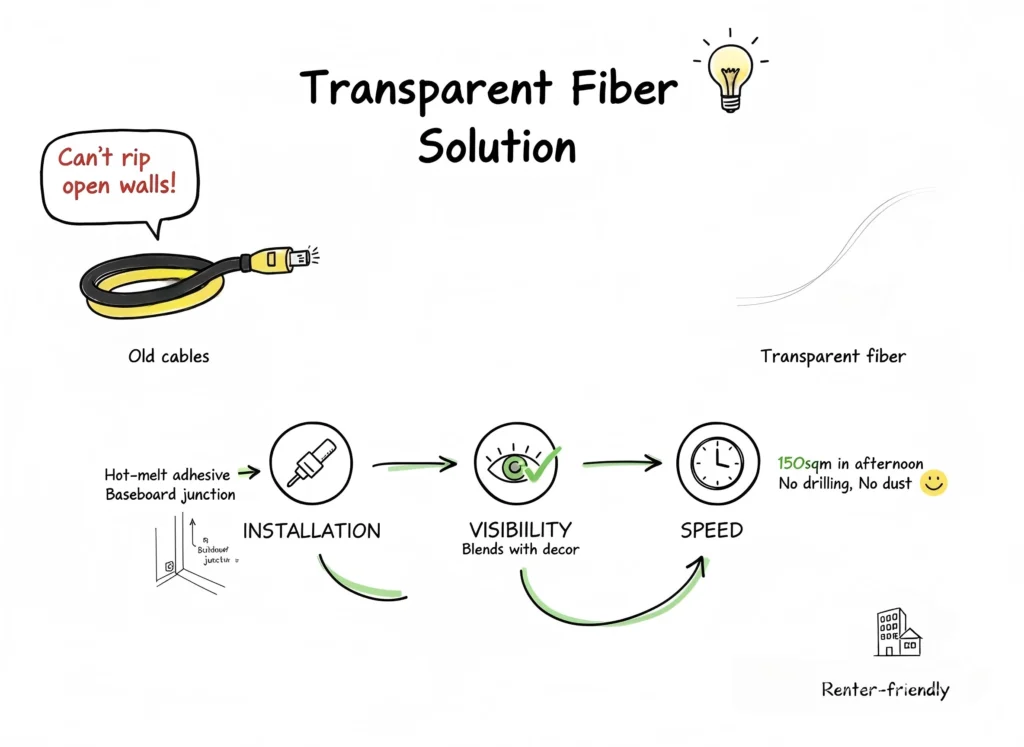
This is the most common objection: “I rent this office/shop, I can’t rip open the walls.”
Vendors have solved this with Transparent Fiber.
Unlike the thick yellow or black cables of the past, FTTR uses ultra-thin, transparent optical cables.
Installation: These are usually adhered to the junction between the baseboard and the wall using a specialized hot-melt adhesive tool.
Visibility: From a distance of one meter, the cable is virtually invisible. It blends into the existing decor.
Speed: A professional team can typically retrofit a 150sqm office or a 4-bedroom home in a single afternoon without drilling massive holes or creating dust.
7. Cost and ROI: When Does FTTR Pay Off?
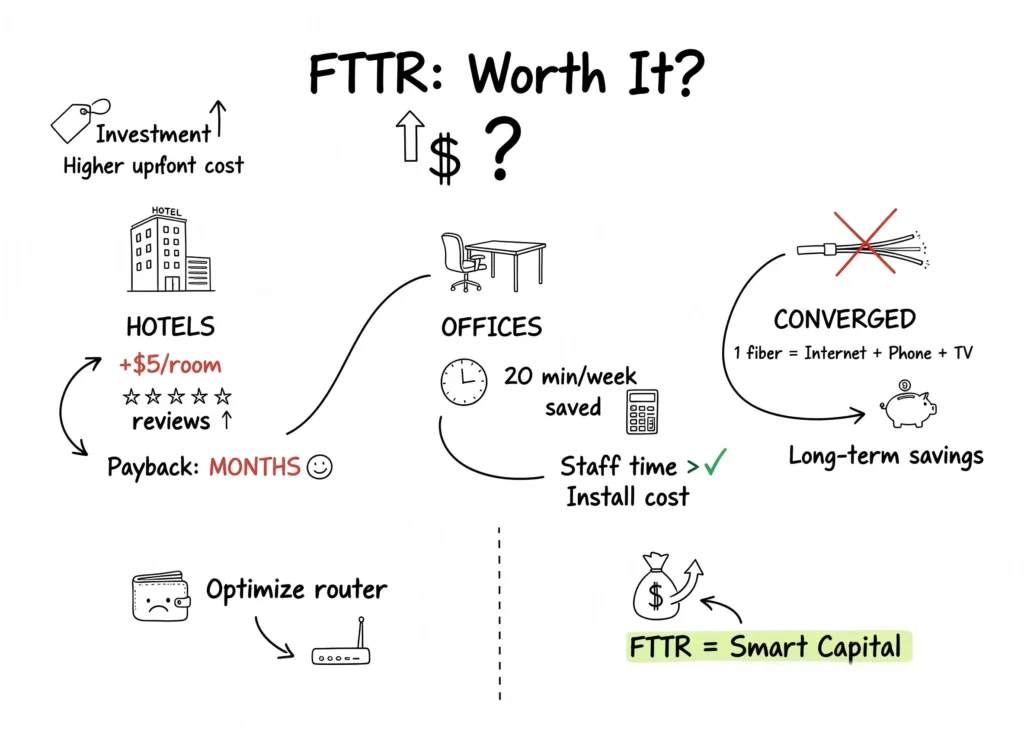
Let’s address the price tag. FTTR is an investment. It will cost more upfront than buying a generic mesh kit from Amazon because it involves skilled labor and specialized hardware.
The ROI Calculation:
For Hotels: If reliable Wi-Fi allows you to increase your room rate by $5 or prevents 10 bad reviews a year, the system pays for itself in months.
For Offices: Calculate the cost of your staff being idle for 20 minutes a week due to network lag. Over a year, that cost far exceeds the installation price of FTTR.
Converged Networks: Instead of running separate cables for internet, phones, and TV, FTTR can carry all these services on one fiber, reducing long-term cabling costs.
Verdict: If your budget is zero, stick to optimizing your router placement. But if connectivity directly impacts your revenue, FTTR is a capital expense with a clear return.
8. How to Get FTTR: From Idea to Deployment
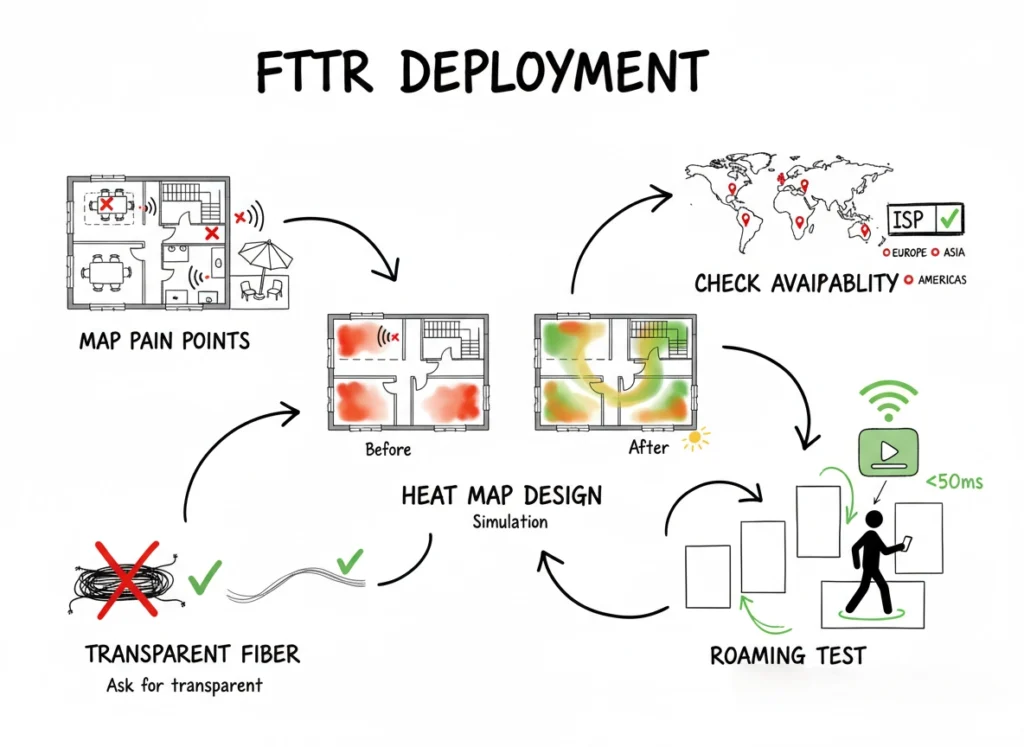
FTTR isn’t usually something you buy off the shelf at an electronics store; it is a service provided by ISPs and professional integrators.
Map Your Pain Points: Identify exactly where the signal drops. Is it the meeting room? The back patio?
Check Local Availability: Operators in China, Europe (France, Spain, Portugal), Southeast Asia (Thailand, Indonesia), and parts of the Middle East are rolling this out aggressively.
Request a “Heat Map” Design: Ask the provider for a simulation. They should be able to show you a floor plan predicting the signal strength in every room before you sign the contract.
Clarify the Cabling: Explicitly ask for “Transparent Fiber” installation to ensure they don’t use standard unsightly cables.
The “Roaming” Test: Before the technician leaves, walk from room to room while on a video call. The handover between access points should be seamless (under 50ms).
9. Quick Checklist: Is FTTR Right for Your Small Business Now?
Use this simple checklist to make a decision. If you check 3 or more boxes, you should request a quote.
You have 3+ rooms or multiple floors requiring strong signal.
Your business relies on real-time video calls or cloud applications.
You have tried Wi-Fi extenders/Mesh before, and they failed to penetrate your walls.
You have high-density usage (many staff or guests online at once).
You are worried about aesthetics and cannot drill into walls for ethernet cables.
You plan to add more smart devices (cameras/sensors) in the next 2 years.
FTTR has graduated from a “nice-to-have” residential luxury to a “must-have” business utility. For small businesses operating in concrete jungles or demanding high reliability, it is currently the most robust way to banish dead zones for good.